From November 2025 to January 2026, we once again invited you to participate in our online user survey. Our goal remained the same as in the previous survey from 2020/2021: to better understand how researchers are using dblp, how our services are perceived, and where we should focus our future efforts. To this end, we employed a version of the questionnaire that was only slightly updated and extended from five years ago, which enables the comparison of the answers.
Again, the response of the community was amazing. We received a total of 534 responses, of which 316 were fully completed and 218 partially completed. This provided us with a wealth of valuable feedback, constructive criticism, and thoughtful suggestions. Your kind words of encouragement also put a smile on our faces. We would like to express our sincere gratitude to everyone who took the time to contribute!
In this blog post, we would like to share the aggregated results of the survey based on all fully completed responses. We will also compare the new statistics to those from five years ago and discuss the key insights we have gained.
Who is using dblp?
As of 2025, the vast majority of our users still come from academia, accounting for 91.8% of respondents. We continue to see a significant number of users from industry (9.8%) and education (12.3%), though the number of responses from these groups was slightly lower than in the survey from five years ago. Only a small percentage of our users come from libraries, governance, and other sectors.
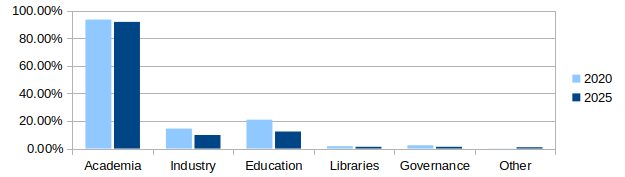
How would you describe your professional background? (multiple answers possible)
In terms of seniority, the distribution remains roughly the same as in previous years: 46.8% of respondents consider themselves early-career researchers, while 53.2% identify as senior researchers. We are particularly pleased to see that dblp continues to be a valuable resource for junior researchers, too, and not just for the “old guard”.
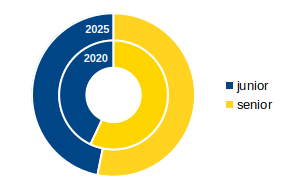
How would you best describe your professional seniority?
This is further reflected in how long people have been using dblp. A remarkable 50.6% of respondents report using dblp for more than 10 years, and more than 71.5% are using dblp for more than 5 years, demonstrating the sustained trust in our service. At the same time, about 5% of users have started using dblp within the past year, showing that our community continues to grow.
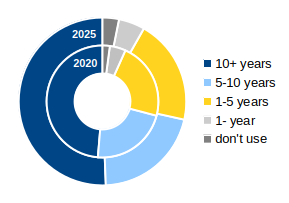
How long have you been using dblp?
How are researchers using dblp?
Based on past user survey results, we compiled a list of “standard” use cases and asked how often you use dblp for each one. The results showed that usage preferences and frequencies have remained remarkably stable over the years, with your responses matching those from 2020 quite closely. The most frequent use case continues to be looking up a given researcher’s publication output. 63.4% of respondents report using this feature at least once a week, and further 22.5% at least once a month. A close second to the most frequent use cases is using dblp to obtain standardized BibTeX data.
While almost all use cases find a regular use by at least 65% of the community, the (expected) outliers are our more specialized features such as querying our open data APIs or downloading our bulk XML or RDF data snapshot releases. With 37.2% and 27.1% respectively, they still remain essential for a dedicated group of “dblp power users.” Feedback from this group highlights the continued importance of open and FAIR bibliographic metadata.
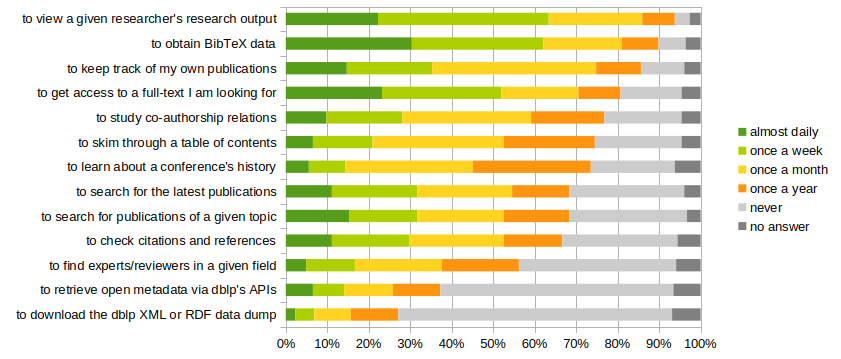
I use dblp …
In the free-text responses, many of you described additional use cases, including the following (in no particular order):
- doing statistics about your own or another researcher’s output
- using dblp as a data source for your own apps and services
- finding different versions (e.g., journal version or open access copy) of a research output
- teaching dblp to your students
- assessing candidates in hiring committees
- using dblp as a dataset for your own research
Are researchers citing dblp in their articles?
In addition to being a research information tool, dblp is also available as a research dataset and has been cited in several thousand articles. However, we are well aware that dblp is cited in those articles in many different ways. Therefore, we were eager to learn how our users usually refer to dblp in their research articles. The answers from 2025 show a surprising discrepancy compared to those from 2020. While 61.2% of researchers in 2020 answered that they cite dblp in the bibliography of their articles, this number dropped to 33.3%. Meanwhile, a staggering 25.9% of researchers said they usually don’t cite dblp at all. As the dblp team is actively working to promote and simplify citing dblp in research articles, we are genuinely puzzled as to whether this is due to some troublesome trend that we are missing or whether there was a misunderstanding when answering this question. (The wording and context of this question did not change between 2020 and 2025.)
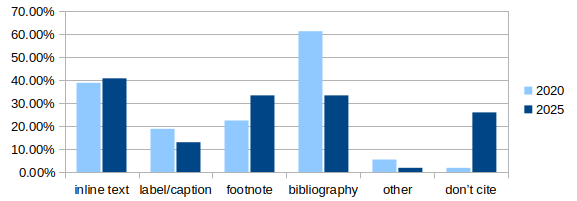
How do you usually refer to or cite dblp in your publications? (multiple answers possible)
All of dblp’s metadata records have been openly available as a daily updated dataset and have been regularly used in research articles since at least the mid-90s. Since 2015, we have been preserving monthly snapshots of the dump download files to enable replication of experiments conducted on dblp data. In 2024, we revised and streamlined the dataset publication process so that the dblp snapshots are now properly identified by DOI and regularly published in the DROPS Artifacts repository. We also asked researchers who are using the dblp datasets if they were aware of these developments. The figures show that we still have a lot of work to do to spread the news. Only 55.7% of researchers knew they could use persistent snapshots in their experiments, and only 38.9% knew each dblp dataset now has a DOI.
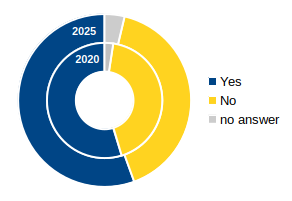
Have you been aware that dblp releases persistent snapshots of the whole dataset in XML and in RDF/N-Triples to enable reproducible experiments?
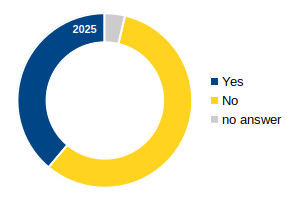
Have you been aware that persistent dblp releases can be cited and retrieved using a DOI?
What are our users thinking of dblp?
The core objective of dblp is to meet the expectations of the international computer science community. This includes disambiguating homonymous and synonymous author names, covering all the most relevant computer science publication venues, and enriching plain metadata with meaningful semantics. Therefore, we asked you to evaluate our performance. We are pleased to learn that the overall perception remains quite positive, with figures from 2025 showing only slight deviation from those from 2020. We are particularly proud that 89.9% of you agree or strongly agree that dblp meets the needs of the computer science research community. Similarly high levels of agreement were observed regarding the quality, neutrality, and coverage of our data. While author disambiguation continues to be probably the most challenging and labor-intensive aspect of dblp, 74.7% of you state that you are still satisfied with our efforts in this area.
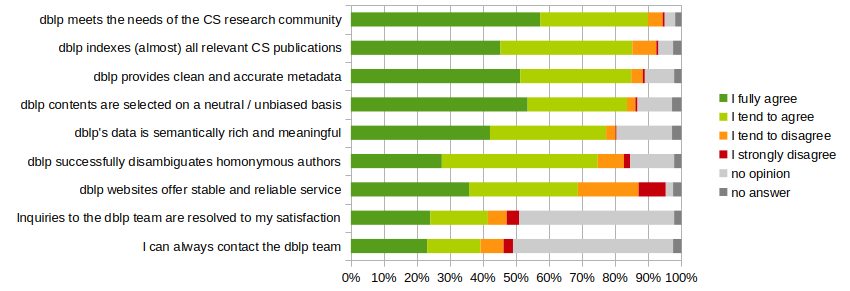
Do you agree or disagree with the following statements?
However, the figures from 2025 also show an increase in dissatisfaction compared to five years ago.
First and foremost, of course, is the elephant in the room: Throughout 2025, there have been incidents of significant, prolonged downtime of the dblp web servers. This was due to a surge of millions of new IP addresses flooding the dblp servers with requests. These new IP addresses actively circumvent existing rate-limiting measures and show no respect for server stability. The combined overload constantly brought our modest server structure to the brink of collapse and sometimes beyond. The root cause of this surge is still unknown. However, the timing coincides with the global boom in AI services and agentic crawlers.
In response, 73.1% of our users stated that they did notice the server outages. This alone is a clear indicator of the problem’s severity. When asked about the outages’ impact, 12% reported severe consequences for their professional activities, and a total of 43.6% reported at least moderate consequences. This is, of course, unacceptable.
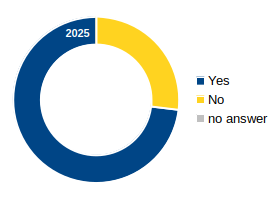
Did you notice that the dblp web servers were unreachable multiple times during the past year?
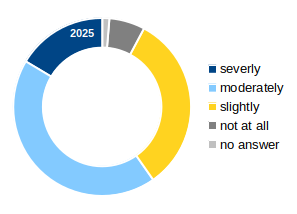
Please tell us how severely the dblp outages impacted your professional activities.
For over a year, our IT team has been battling the surge in requests by bolstering security measures and allocating more resources to meet the increased demand. Our first wave of measures stabilized the servers without compromising our goal of making our data freely and openly available to all. However, the core problem has not yet been solved, and the number of requests is still rising. We have several more radical measures planned to future-proof the service, which we hope will come to fruition during the course of this year.
A second area of critique addressed the process of submitting error correction requests and indexing inquiries to the dblp team. Nearly 9.8% and 9.4% of our users, respectively, expressed dissatisfaction with the provided means and resolutions of such requests. This comes as no big surprise to us. Throughout 2025, we experienced a significant increase in support requests. Platforms like OpenReview.net now make extensive use of dblp data, which has resulted in the addition of new communities to dblp that have not been avid dblp users before. Consequently, the number of daily requests we received increased by 53.3% from 2024 to 2025 alone, surpassing the number in 2020 by more than twofold. As our team size has remained essentially stable during this period, we now spend a significantly larger fraction of our time addressing user requests. Whereas we used to be able to handle and resolve most inquiries within just a few days, now we have an ever-present backlog of hundreds of support requests that must wait weeks, if not months, to be addressed.
We acknowledge that this situation is not ideal and understand that it leads to frustration. After all, we want to hear from you, as your requests and firsthand information are valuable for curating the database. Your support is always highly appreciated! Please rest assured that, although waiting times have increased and we don’t always have the time or resources to respond to every email, we read and consider each message. Most data correction requests are just silently executed as soon as we get to them, and all content suggestions are vetted for viability.
How does dblp compare to other services?
As in 2020, we asked you to compare the usefulness of dblp with that of other research information services. The results closely mirrored those of the previous survey: dblp is generally perceived as a highly useful service that often outperformed other domain-specific and multidisciplinary services. The one notable exception is the relationship between dblp and Google Scholar, which our users consider complementary rather than competitive. Many respondents emphasized in their comments that they use both services for different purposes and appreciate dblp’s curated, structured metadata as well as Google’s more powerful search capabilities.
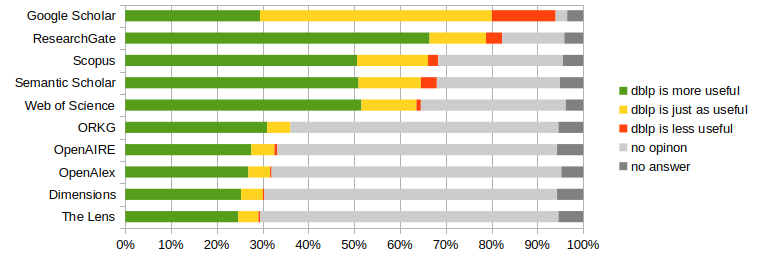
How do you rate dblp compared to these other research information tools?
Further development
Beyond the quantitative results, your free-text responses also provided invaluable insights. Many of those comments addressed missing features our components that are in dire need for an upgrade. Here are some of the most frequently mentioned items:
- dblp desperately needs a mobile-friendly web interface
- the integrated dblp search needs a major update, and it should provide a much richer search syntax
- the documentation of dblp’s open data API is either insufficient or missing altogether
- the website needs a global setting to show/hide certain publications types that persists when browsing across different author bibliographies
- more customizable options for the BibTeX export format
- more metadata export formats in general, but especially JSON
- dblp needs to fully support Unicode characters in names, and not just the old Latin-1 subset
- dblp is already providing openly available citation links for most of our listed publications (both on a paper’s “details & citations” page and in the dblp SPARQL Query Service) – but only very few people seem to know about it!
The good news is that essentially all of the features listed above are already on our radar. In fact, we are actively working on some of them right now. Unfortunately, we cannot provide a release date for those features, yet. Sorry.
There have also been requests for features that we, as a team, have consciously opted against in the past. While we understand the motivation behind those suggestions and the perceived benefits, we still believe it would be better for the service not to follow those paths:
- allow crowd editing of dblp: We understand the effectiveness and scalability that comes with the crowd. After all, we are all huge fans of Wikipedia and Wikidata. But we are convinced that unique approach of dblp – that is, having a dedicated, trained team of editors managing and controlling the content and the semantics of the database – has proven to guarantee the level of data quality and reliability that our users expect from us.
- add scientometrics and rankings to dblp: We see our role as neutral providers of quality-checked, open data. We leave the task of performing statistics and determining which type of statistics is the right one to do to those who are much more proficient in that area than we are. They are of course welcome to use our data for that purpose, if they like.
- index venues beyond computer science: The dblp metadata curation and semantic augmentation process is very labor-intensive, and our small team is already working at maximum capacity. We rather choose to do what we do well just within our field of expertise instead of failing to meet expectations in other fields.
Once again, we would like to thank everyone who participated in the survey. Your feedback is invaluable in helping us to improve dblp and ensure that it continues to meet the needs of the community. If you happen to have missed the survey or if there is anything else you would liker to share with us, please always feel free to send us your thoughts to dblp@dagstuhl.de.